

One of the reasons people love die cast parts is because it allows you to create complex 3-D shapes at very low piece cost. When you select a casting, you have much more freedom to design a perfect part for your application at a competitive cost.
Designing zinc parts well requires more than selecting the right alloy. While understanding material properties is important for optimal design, the features and shape of the part are far more impactful to the overall product performance.
The design of your product is also a critical component of managing total cost. Subtle features of the part can the difference between a part that runs well with low tooling cost or a part that runs poorly, has expensive tooling, or tooling designs that will wear out early.
Considering these factors together from the beginning leads to a part with better performance and lower total cost. At Deco Products, our engineering team works closely with our customers to help them get the most out of their products while managing costs. Our team will work closely with your engineers and product designers to help channel products toward the best practices and design considerations for the given need of your product. This enables us to help you get the most out of your zinc die cast product.
Start With the Application
Before selecting an alloy or considering geometry, it’s crucial to define the part’s purpose. Clearly understanding how the finished product functions, what loads, it will experience, what tolerances it requires, and how it will interact with other parts allow us to identify which features can be tweaked and which features are a must-have in the final design.
A part that needs to hold tight tolerances in a high-volume product requires different design considerations and work-center considerations than a part that is low volume or more forgiving tolerances. The amount of visual requirements or decorative function will also play a key role in operational design of the product. Strength requirements, corrosion resistance, and expected environmental exposure will impact how we suggest designing the product and assessing surface protection or coatings.
The more precisely the requirements of the end product can be defined, the easier it is to know exactly how the part can be manufactured to conform at the best total cost. The more latitude we have in requirements, the easier it is to make creative suggestions to help minimize total project costs.
Design for Manufacturing from Day One
Designing-for-manufacturablitity is one of the most important best practices in the entire product development process. A design that works well on paper may create significant challenges in production — and those challenges carry real costs.
Often, subtle changes in draft, parting lines, or flat surfaces can be the difference between an expensive part and an inexpensive part. When customers engage our engineering team early, we can review the part design. This allows us to identify potential issues before any steel is cut to make the tool. Common concerns include wall thickness, draft angles, feature placement, and undercuts that create complexity or risk in the tooling.
For example, a non-essential feature could dramatically impact tool cost and risk of accelerated replacement by adding additional slides or cores to create the feature. Those slides need to insert and retract from the cavity with each shot, creating wear points, maintenance concerns, and additional stoppage time to maintain the tool.
A small geometry change early in the design process can eliminate that slide entirely and extend tool life significantly. Our engineers can notify your team in advance of the project of which features are likely to create tooling cost or tooling complexity by helping your team understand how the tool will be fabricated to acheive the final product.
This step of the design review can help optimize both the upfront cost of tooling and the long-term cost of tool upkeep and replacement over the life of the product. A great and robust tool design with a simple geometry can help tools last millions of shots, helping improve your ROI and reducing your overall CAPEX budget throughout the duration of the project.
Features for Weight Reduction
Zinc’s excellent fluidity allows designers to work with thinner walls than most other casting metals can achieve. Zinc’s high fluidity allows for creative ways to reduce total product weight, which is one of the easiest ways to reduce total cost:
- Walls can be made thinner when working with a zinc casting. In some applications, the walls can be as thin as 7.9 thousandths of an inch (0.2 millimeters).
- Fine ribs can easily be added to enhance the rigidity of the finished part, adding strength without significant weight.
- Metal saving features can be added in various locations with high confidence the part will continue to fill correctly.
Our engineering team reviews these considerations during the design for manufacturability process. This helps you optimize your geometry for performance and long-term cost.
Consider Surface Finish Requirements
Surface finishing is not just a cosmetic consideration — it is part of the design process. Zinc die castings support a wide range of surface finish options, including powder coating, plating, painting, and chromating. The zinc casting process produces a smooth surface skin that requires minimal preparation for most finishing operations.
The type of finish required influences design decisions around draft angles, parting line placement, and surface texture requirements. A part designed for a high-gloss plated finish has different requirements than a part that will be powder coated or left unfinished.
Planning for the intended finish during the design phase avoids costly surprises at the end of the production process. Our team helps customers consider their finishing requirements early in the process. This ensures that the part design, tooling design, and finishing process all work together effectively.
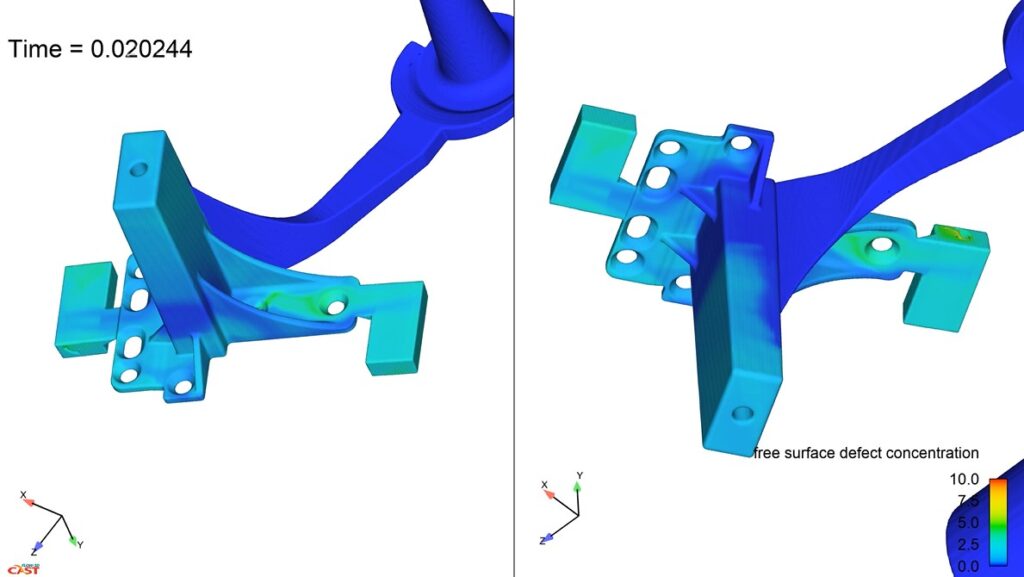
Mold Flow Simulation — Validating the Design
Any high-pressure casting results in some amount of air getting trapped in the part. This entrapped air is referred to as “porosity”. A well-designed casting helps ensure any entrapped air is deep in the part and doesn’t impact the parts performance. Porosity in the wrong place can create leaks, compromise strength, or create surface defects.
Mold flow simulation is an amazing technology that allows our engineers to simulate the flow of metal into your part in a virtual environment. This allows us to anticipate how gating, overflows, and the product design are likely to fuction in practice. The simulation tracks velocity, temperature, and pressure as the metal moves through the cavity and solidifies.
Although mold-flow is an imperfect representation of reality, these simulations go a long way in helping our team ensure the product design and the tool design can work together to control the total cost of quality and provide a high-quality product. When we encounter concerns, we can experiment with different ways to flow metal through the tool and identify potential product design concerns or opportunities before we start cutting steel for the tool. This approach gives our team data-driven confidence in the final tool design.
Select the Right Zinc Alloy
The material properties of zinc make it a strong candidate across a wide range of applications. Zinc alloys allow for continued optimization of the product.
At the outset, zinc offers excellent fluidity, natural corrosion resistance, high dimensional stability, and a low melting point that supports energy-efficient, high-speed production.
Deco Products works with a variety of zamak alloys to help ensure we can offer the mechanical characteristics suited to specific applications of our customers. Thus, with no change in design, we can help support our customers with better fluidity or better impact resistance based on the needs of the product. The discrete zamak alloys allow for customers to identify their ideal combination of strength, castability, fluidity, and cost. Many of our customers find that Zamak #3 is the right balance of cost and performance, but we frequently support other alloys to support the individual needs of your product.
An alloy that performs well in one application may not be the best fit for another. Once the design is optimized, our engineering team assists customers in evaluating their alloy options early in the process. This enables designers to optimize the design and material properties of zinc together.
Bring Deco In Early
The best zinc part designs start with collaboration. Our engineering team is extensive and experienced. We offer Design for Manufacturability consultation for every project.
We review designs and run mold flow simulations. We also evaluate alloy options and assist customers in optimizing their parts for quality, performance, and total cost.
The sooner you involve us in your design process, the more value we can add. Reach out to our team to discuss your next zinc die casting project.
FAQ: Designing Zinc Parts for Optimal Performance
Q: What are the most important factors to consider when designing zinc die cast parts?
A: The part’s functional requirements are crucial. You also need to consider the right zinc alloy, wall thickness, draft angles, and feature placement for the application.
Designing for manufacturability from the beginning has a significant effect on part quality and tool life. It also helps reduce total production costs.
Q: How do you choose the right zinc alloy for a die casting project?
A: Ultimately, the design matters most when optimizing a castings performance. If the alloy type needs to change, that is usually an easy change that does not require retooling.
As such, we generally tend to encourage customers to start with Zamak #3 and evaluate that performance once samples are ready.
In cases where customers know they have a specific need, speciality alloys offer an opportunity to emphasize a specific characteristic. You can read more about the differences between alloys <HERE>
Q: What is designing for manufacturability, and why does it matter for zinc castings?
A: Designing for manufacturability (dfm) means reviewing a part design with the production process in mind. Evaluating wall thickness, draft angles, undercuts, and feature placement to ensure the part can be produced consistently and cost-effectively. DFM decisions made early in the design process significantly impact the quality of zinc die castings. These choices also influence tool life and production costs over the product’s lifespan.
Q: How does mold flow simulation improve zinc part design?
A: Mold flow simulation allows engineers to model how molten zinc will move through the die cavity before the tool is ever built. It identifies potential problems like trapped air, incomplete fill, and uneven cooling that could cause porosity or surface defects. Catching these issues at the design stage avoids costly tooling rework and shortens time-to-market.
Q: Can zinc die-cast parts replace machined or stamped metal parts?
A: Zinc die casting can create complex three-dimensional shapes in one operation. This efficiency means it often eliminates the need for multiple machining or stamping steps, making it favorable to other types of manufacturing processes when a complex shape is required.
For parts with high volume demand, zinc die casting offers a lower piece price. It also provides a longer tool life. These advantages usually lead to a better total cost when compared to machined or stamped alternatives. Combining secondary operations into the casting design itself is especially beneficial.