
When we ask customers if they have any needs for zinc diecasting, the routinely look to see if they have spend in the zinc category. If they don’t have a spend on zinc castings, they may be quick to say “no”.
However, it is often the case that a zinc die casting can create economic value by converting other metal parts into a casting. This may not be possible over a wide swath of products, but we routinely find opportunities to improve total price-performance for our customers by creatively considering conversion opportunities. One such interesting opportunity is converting an aluminum extrusion to a zinc casting. At first glance, extrusions are radically different from die castings and have very little overlap. However, where the two products can overlap often results in overlooked opportunities for value engineering.
Understanding the Two Processes
Extrusions
The extrusion process forces an aluminum billet through an extrusion die to create a continuous profile. This produces material with a uniform cross-section and extends along the entire length of the extrusion.
Extrusions are a perfect solution for creating a linear product of any length. In many cases, extrusion stock can be run in very long pieces and cut down to length for particular use cases. This means the product has exceptional economy of scale.
Extrusions also have relatively low tooling cost. As the extrusion process requires less pressure and fewer moving parts, tools are significantly less expensive than die cast tooling.
Die Casting
Die casting process is radically different than extruding. Die casting uses molten metal injected into a steel tool under high pressure. The tool forms a complex geometry that allow for the creation of a complex shape each time the machine cycles.
Die casting excels at the ability to make a relatively short but complicated shape–almost completely the opposite of extrusions. Additionally, since the die cast part must fit within a steel tool, die cast parts are radically limited in length compared to extrusion.
Diecasting tooling is also quite expensive compared to an extrusion. This is because nearly every feature of the final part has to be meticulously machined or burned out of a hardened steel tool
Extrusion Conversion -- Exploring the Overlap
There is a very specific range of parts where extrusions and die-casting overlap, where diecasting can potentially create greater value. Below is an exploration of each of the attributes necessary for conversion.
1) The EAU is greater than 50,000 pieces
In order to amortize the tooling cost to a reasonable level compared to extrusion production, its important to have a sufficient volume. Zinc die-casting tooling can last well beyond one million shots when the geometry is simple, so the higher the EAU, the less the initial costs of tooling will matter.
2) Total length is shorter than 18 inches
As discussed above, this is a question of practical limitations. For parts longer than 18 inches, tooling and machine cost becomes very expensive. Anything beyond 18 inches is likely infeasible for a conversion opportunity.
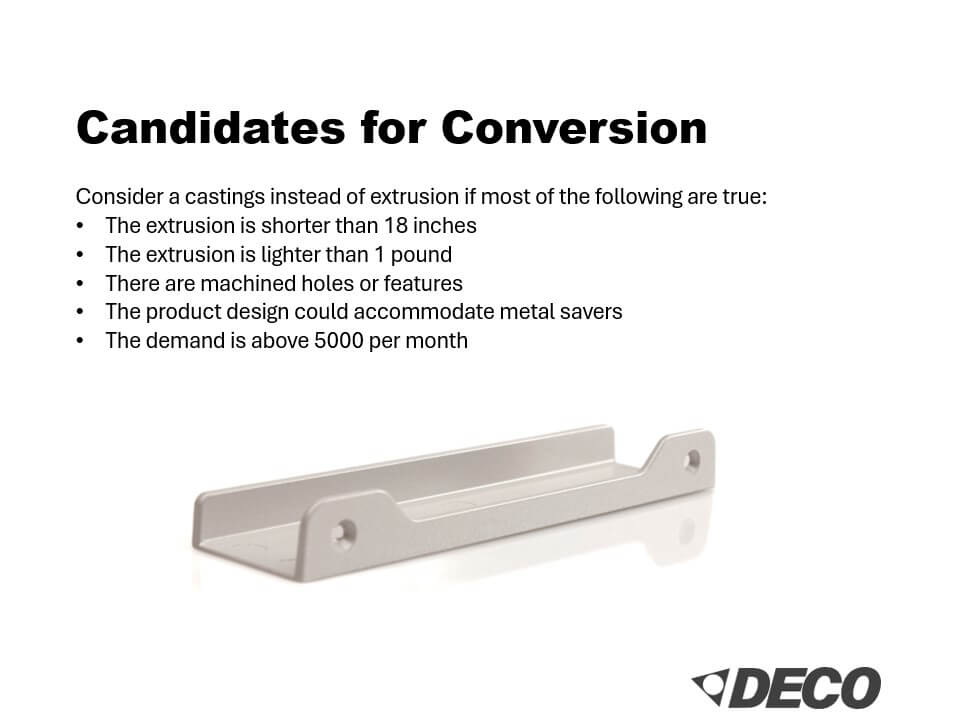
3) Holes or end features are required
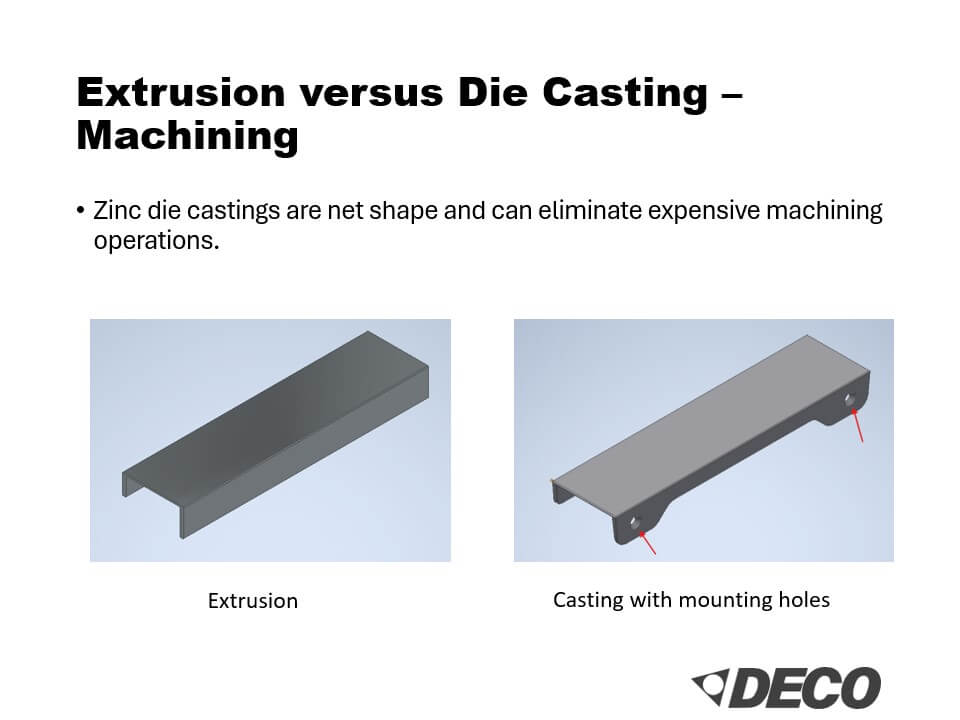
This is really where all of the value is created. Extrusions are dramatically cheaper than zinc castings unless they require additional machining operations. Often these machining operations will require individual piece flow through relatively expensive machines.
If the final product needs holes or special end shapes, these features can be added into the die itself. This can prevent the need for downstream machining operations and significantly improve total cost of the product. Thanks to the ability to design tapered, radiused, or contoured ends within the die, die castings can providing a better and safer end-customer experience with the product.
4) The Design can incorporate Metal Savers
A “metal saver” is a design feature that reduces or eliminates the material needed to produce the product. For example, a part could have thinner walls with reinforcing ribs, rather than thick walls thanks to the mechanical properties and strength of zinc. Parts can also be designed with holes or slots to reduce the overall metal used.
In extrusion, the material use is continuous as the billet is extruded. This continuous process allows for inexpensive production, but doesn’t allow for metal saving design.
If the part is produced as a casting, there are creative ways to help reduce the material cost of the product to make the pricing more competitive, such as adding ribs or removing material. When the design is flexible, there are better opportunities to consider conversion to a casting.
An Important Time to Review Conversion
Extrusion is an amazing manufacturing method for economically producing parts. Extrusion is almost always the right choice when the part is long, has a uniform profile, and has no machining or secondary operation needs beyond cutting to length.
However, when parts are short, require secondary operations, and have a higher volume, there may be an opportunity to consider a cost effective conversion to a casting instead of utilizing extrusion.
At Deco Products, we recently reviewed a customer’s design of an extruded aluminum profile. The part was functional, but it required several machining operations and created avoidable cost. This part is a perfect example of converting a high-volume extrusion into a zinc die casting.
With the supply-chain uncertainty and tariff impact on aluminum, now is a perfect time to re-evaluate if any aluminum extrusions may be convertible to a zinc casting. Our zinc supply chain in the US is primarily sourced out of Canada and remains tariff free, creating both price and supply stability compared to other metals.
If you’re wondering whether your next designs should be castings or extrusions, our engineering team can help. We’ll review your design, identify opportunities to reduce machining, and recommend casting-friendly solutions for performance, cost, and manufacturability.
Read on if you’re curious about Zinc vs Die Cast Aluminum