

Innovate with Metal Casting
The market continually pushes companies to provide more, better, faster, and for less. For new and emerging products, this means re-evaluating designs and manufacturing processes to provide differentiated performance in higher volumes as the product demand grows. For mature and established products, this means innovating cost reductions by streamlining operations and value-engineering the solution.
Casting is a manufacturing process which is frequently a solution for both of these use-cases. Casting is an excellent way to scale up a new or innovative product design once the prototype has been established: Customers are able to invest in tooling to make many complex parts quickly and at competitive cost. There may be significant tooling costs up front, so it is important to have a good design established prior to converting to a casting process
Casting is also an excellent way to achieve significant cost savings for established product lines. Castings allow Product Engineers to eliminate operations, eliminate bill-of-material complexity, and better align the performance needs of the product to the performance of the material.
What Is Die Casting?
Die casting is a “net shape” manufacturing process, which creates a 3-dimensional part by filling a cavity with material to form the part. It practice, its not that different from making a waffle: you use a liquid material, place it in the cavity of two-halves of a waffle-patterned mold, produce a solid shape that fits the mold, and re-open the form to extract the finished part.
Likewise, in diecasting, we melt metal down to a liquid state, inject the liquid metal into a cavity in a mold, let the liquid metal form the shape of the cavity, and open the mold up to extract the part. If you are injecting the metal, this is considered high-pressure die casting.
There are many types of die casting methods and materials used for casting applications, but at Deco we exclusively perform high pressure zinc die casting.
Advantages of Zinc in Manufacturing
Think Zinc
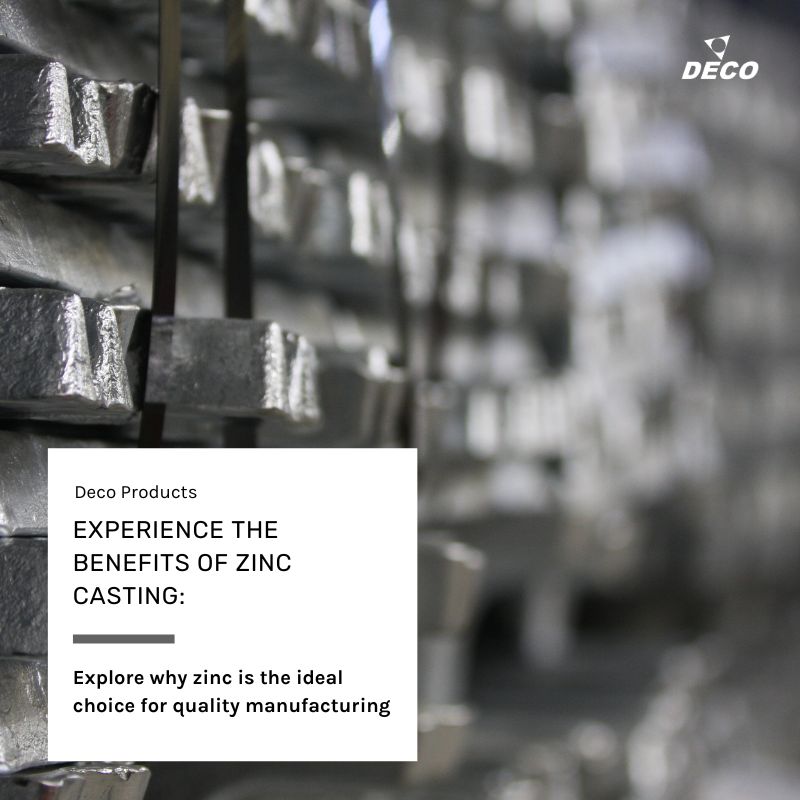
At Deco, we are experts in zinc casting. While there are many metals to choose from in the casting world, Zamak alloys have a compelling value proposition: they are versatile, perform well, and provide great total cost in many settings. Zamak is a precise manufacturing alloy composed of Zinc, Magnesium, Aluminum, and Copper. Although pure zinc can be soft and pliable, Zamak alloy is incredibly strong and can flow like water in a molten state. These attributes combine to support a wide range of use-cases for Zamak alloy.
Precision and Detail
One of zinc’s biggest advantages is how well it flows in a molten state. It can fill thin walls, small features, tight corners, and complex shapes. This allows engineers to design detailed parts that may be harder or more expensive to make with other materials. Zinc’s fluidity also supports tight tolerances and can form features that need to be machined into other materials. For engineers, this means more design freedom.
Low Melting Temperature
The melting temperature of zinc is also lower than that of other casting metals. Zinc die-casting alloys generally cast at around 800°F. This is much lower than many other casting metals, such as aluminum. The low melting temp makes zinc more energy efficient, allows for faster production cycles.
Long Tool Life
The low melting point of zinc also means that the manufacturing process creates less thermal shock and erosion than the other casting metals using in high pressure casting. This helps extend the tool life. Long tool life is one of the most important cost advantages of zinc for high-volume production: Longer tool life helps save money, reduce downtime, and protect the bottom line. Extended tool life maximizes return on investment.
Strength and Durability
Zinc castings are dense. The Zamak alloy produces a strong, rigid part, with outstanding impact strength. The density of zinc also makes the parts feel heavy. While this can be detrimental in weight-sensitive applications like aerospace or automotive uses, other applications benefit greatly from the extra weight due to the high density. This makes zinc a good fit for structural and functional parts.
Elimination of Operations
In many cases, zinc can also replace multi-piece assemblies. Casting with zinc can create many fine features such as ribs, bosses, holes, and mounting points directly into the part. That helps simplify production and create a quality product with fewer steps.
Corrosion Resistance
Zinc is naturally corrosion-resistant. Castings made from zamak alloy form a natural patina of zinc-oxide on the surface of the casting. This patina forms a protective surface layer that helps defend against corrosion over time.
Surface Finish Quality
Thanks to the excellent fluidity of zinc, it is possible to make castings with a smooth and beautiful surface. Zinc castings can be a natural choice when selecting component that may have an aesthetic requirement. Zamak castings are an excellent substrate for plating, powder coating, and other finishes thanks to the ability to cast these smooth surfaces.
Competitive Cost
The true cost of a part is more than its piece price. It includes tooling, production speed, scrap, machining, finishing, labor, quality issues, and long-term maintenance.
Zinc die casting significantly reduces costs in several ways:
- Faster cycle times
- Lower energy use
- Longer tool life
- Less machining
- Fewer secondary operations
- Less material waste
- More consistent part quality
Because zinc solidifies quickly, production cycles can be fast. That improves output and helps lower machine and labor costs per part.
Zinc supports net-shape and near-net-shape production. Features directly designed into the part reduce the need for machining. When a part needs bosses, ribs, holes, decorative surfaces, or complex contours, zinc can often form them in the casting process.
This is different from simple cost-cutting. Cost-cutting can sometimes reduce quality. Zinc supports cost optimization by improving the design and production process itself.
For many customers, that creates cost-effective products without sacrificing strength, precision, or reliability.
Sustainability and Material Efficiency
Zinc is also a practical choice for manufacturers focused on material efficiency. You can remelt and reuse zinc casting scrap, runners, and excess material. This reduces waste and in the production process.
The lower melting temperature of zinc can also reduce energy demand compared with higher-temperature casting metals. These benefits support both responsible production and cost-effective manufacturing.
Zinc Compared to Other Manufacturing Processes
Every process has a place. The right choice depends on part size, volume, geometry, cost, and performance needs.
Zinc vs. Aluminum Casting
Zinc and aluminum die casting are similar processes, but they often fit different applications.
Aluminum is an excellent option for larger parts or parts where low weight is the top priority. Zinc is often a better choice for smaller, detailed, high-volume parts that need tight tolerances and long tool life.
Because zinc casts at a lower temperature, it can be more economical over the full life of a high-volume program.
Zinc vs. Stamping
Stamping is an exceptionally cost-efficient process which works well for flat or formed sheet metal parts. But stamping can dramatically limit the shape of parts without additional assembly operations.
When a part needs 3D detail, built-in features, or less assembly, zinc die casting may be a better option. A zinc casting can often replace several stamped, bent, welded, or assembled parts.
Zinc vs. Plastic
Plastic injection molding can be low-cost. But plastic does not match zinc for strength or rigidity. It is also lighter and less dimensionally stable. Additionally, plastic is much less dense, making it more efficient in weight-sensitive applications, but with a much lower perception of a premium product.
Designers often select zinc when a part needs to feel durable, resist wear, or perform under stress. In applications where plastic may crack, loosen, or deform, zinc can provide a stronger long-term solution.
Zinc vs. Machining
Machining is flexible, but it can be expensive at production volumes due to the slow cycle times. It also removes material to create the final shape. Machining makes great sense when prototyping or working with very low volumes where it is better to pay a higher piece price rather than investing in tooling assets.
Zinc die casting has fast cycle-times and lower product cost. However, die-casting requires an investment in a steel tool to make the parts. As such, die-casting makes more sense once the volumes warrant the up front investment for the down-stream savings.
Deco’s Zinc Die Casting Process
At Deco Products, every job begins with tool design. Our engineering team reviews the part design and develops tooling to support quality, consistency, and manufacturability.
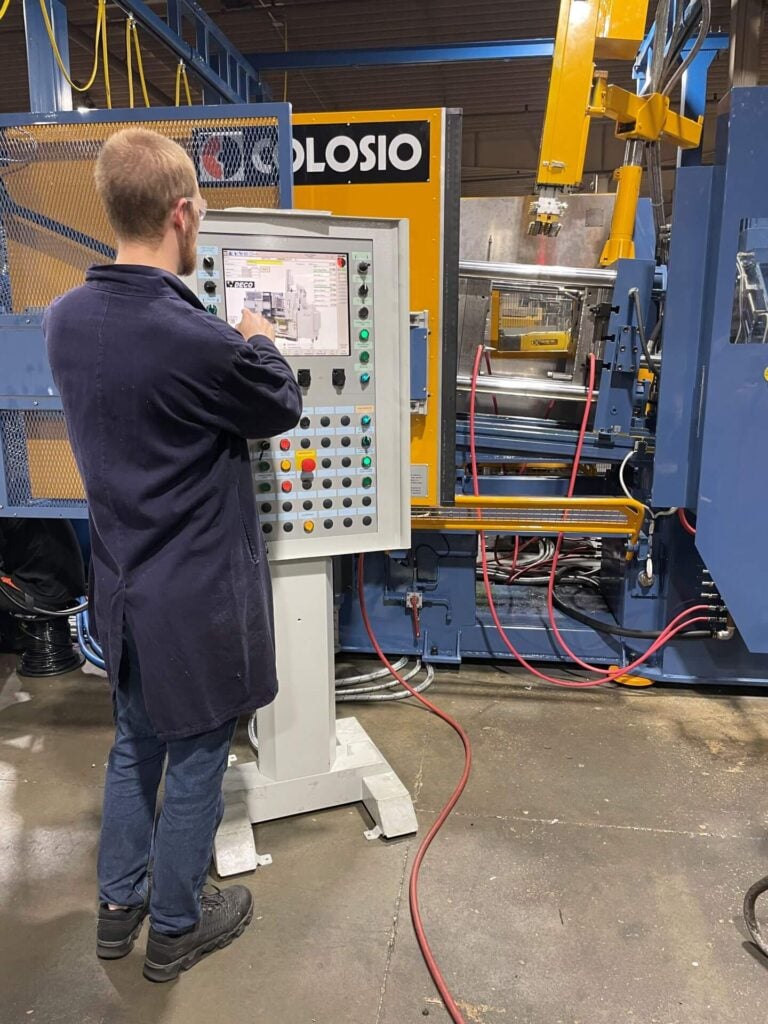
After the tool is designed and samples are approved, we can proceed with production. During the production process, a hydraulic cylinder rapidly forces zinc into the die under high pressure. The metal fills the cavity and cools quickly. After the part solidifies, the die opens and ejects the casting.
After casting, parts may undergo finishing steps such as degating, trimming, tumbling, machining, powder coating, plating, assembly, or packaging.
Partner with Deco Products
Deco has been an expert in zinc casting manufacturing for over 65 years. Our goal is to help our customers deliver best total value and save costs by providing reliable and high-quality product with excellent support throughout the life of the customer product lines.
Creating value in the supply chain with zinc castings is often a product engineering question, rather than a procurement question. Our engineers help you maximize total economic value not by simply cutting costs, but by understanding the needs of the design in the application.
Deco works with customers early to review part designs and identify opportunities for design improvement and cost management. We can also help support your selection of the right raw materials to support your applications needs.
Our team may recommend changes to wall thickness, metal savers, draft angles, ribs, gate locations, surface finish requirements, or secondary operations. Small changes can make a substantial difference. Better design can reduce cost, improve metal flow, reduce scrap, limit machining, reduce tooling cost, and extend tool life.
Whether you are designing a new part, Deco can help. Deco can also help you compare zinc alloys with other materials. If you need reliable products and services from a domestic partner, Deco is ready to support you. We understand the importance of a reliable supply chain.
Contact our team to discuss your next zinc die casting project.